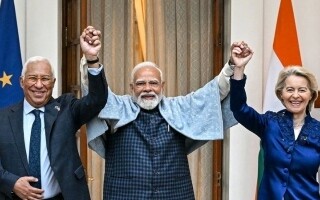
In 2007, businessman and late inventor Steve Jobs announced the launch of the first iPhone, the US subprime mortgage crisis worsened, the European Union expanded to include Romania and Bulgaria, and India became a trillion-dollar economy for the first time. At that time, trade talks began between India and the European Union for the first time, but the agreement was only signed last week, after almost 20 years, following a few months of unusually intense negotiations. Last Tuesday, President of the European Commission Ursula von der Leyen, President of the European Council Antonio Costa, and Indian Prime Minister Narendra Modi announced a massive deal, dubbed 'the mother of all deals,' promising to bring together nearly two billion consumers and a quarter of the global GDP. This deal opens up parts of India's famously protectionist local market, with a focus on exporting manufactured goods and services. In return, India's middle class will find that European goods, such as cars, will become cheaper. In return, Indian middle-class consumers will find that buying European cars is cheaper. In fact, the comprehensive strategic agenda between the EU and India is much broader, covering defense and security, commitments to multipolarity, mobility, and cooperation in several areas. But why this sudden shift after 20 years of on-and-off negotiations? The answer here is related to the American president, Donald Trump, and reveals the features of a new 'post-American' world order amid continuous threats to regional sovereignty, punitive tariffs, and a decline in the role of multilateral institutions. The original talks started slowly over disagreements on cars, alcohol, agriculture, and dairy, but were shelved by 2013. They were resumed in 2022 as the world, after a period of the COVID-19 pandemic, sought to de-risk and diversify supply chains away from China. Yet paradoxically, the deal came to fruition not because of China, but because of Trump's looming worldview. In December 2024, even before the ceremonies of his second presidential term, Trump sought to scare Europe by again raising the prospect of annexing Greenland to the United States. How can an allied state threaten regional sovereignty, leading to a widespread feeling that Europe is 'alone inside' amidst tensions in the transatlantic relationship. To make matters worse, on his first day in office, Trump imposed punitive tariffs on America's neighbors, Canada and Mexico, a move that culminated in 'Liberation Day,' when he imposed tariffs on 90 countries worldwide. India was subject to one of the highest tariff rates, reaching 50%, including a 25% increase for buying discounted Russian oil. Finally, the weapon of tariffs was turned again against the EU and the UK when eight countries sent troops from Nato to Greenland. As a result, recent public opinion polls show the US is no longer seen as a trustworthy country in Europe, but is viewed as an explicit threat. Concepts like 'de-risking' and 'decoupling' have come back to the fore in Europe, but this time the target is America under Trump, not China. And it's not just about supply chains, but also the strategic capacity to resist coercion. The French government's recent decision to ban officials from using American video-conferencing apps like Zoom and instead promote the local 'Visio' platform is a clear example of this. This trade deal between India and the EU is the largest of its kind, but it is part of a growing trend of many countries trying to forge alliances. Brussels has finally reached a trade deal with the South American trade bloc Mercosur, and several other agreements are in the works. India has signed deals with the UK and New Zealand in the recent months. Despite ratification and implementation taking time and facing potential hurdles, like the delay in the EU-Mercosur deal, they point to an unmistakable shift. The world that many outside the West have long dreamed of—a multipolar world, strategic autonomy, and even moving away from the dollar—is beginning to take shape, slowly at first, then with speed. A day before the India-Europe summit, EU leaders were, for the first time, guests of honor at India's Republic Day celebrations, where they were invited to witness the military parade and festivities. The images that emerged painted a world entirely different from the gloom that has hung over the European mood in recent months, reflecting a spirit of bonhomie and even optimism. The world keeps moving, while America looks on alone.